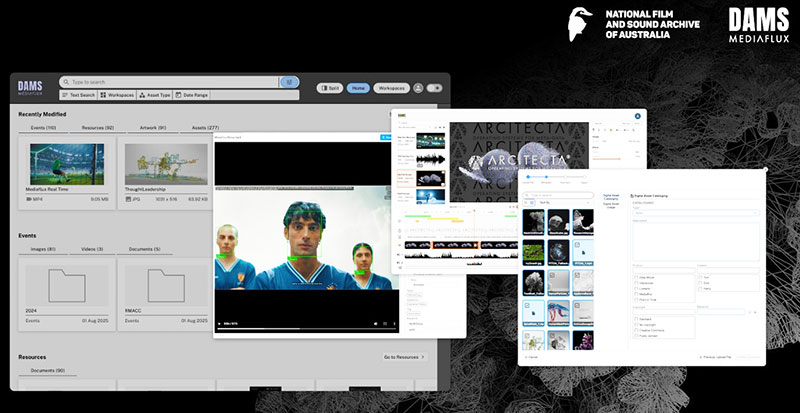


New AI-driven search, MediaSilo collaboration capabilities, and scalable NVMe storage help media teams manage, discover and monetise rapidly growing content libraries.

EditShare’s attention was on AI-powered media operations and high-performance NVMe storage at the 2026 NAB Show – specifically, showing how broadcasters, post facilities and production teams can manage growing content volumes without increasing complexity in their operations.
AI and Intelligent Workflows
EditShare’s approach centres on Analytical AI, analysing media to identify and structure information such as speech, faces, text and scenes. Unlike generative AI systems that create new content, Analytical AI focuses on understanding existing media, automatically enriching files with metadata that makes video searchable. Integrated across the EditShare platform and accelerated by high-bandwidth shared storage, these capabilities allow teams to find the clips they need more quickly, from across their media libraries.
In 2026, analytical AI at EditShare has moved from an interesting tool to a foundational part of the platform. CEO of EditShare Brad Turner said, “The real opportunity is the ability to analyse video at scale and make that intelligence usable across the entire workflow. Whether media lives on-premise with our FLOW asset manager or in the cloud with MediaSilo, teams can instantly search their libraries and find the moments they need.”
The most recent version of EditShare’s unified interface EditShare One was shown, giving a simplified operational view across storage, asset management and automated, AI-powered workflows. Within the FLOW asset management platform, AI-generated metadata can be used to set up automation and management workflows that operate without manual tagging. Creative teams can work with media libraries and archives as dynamic, discoverable assets from the start – instead of spending hours on manual data entry, every frame is automatically indexed and becomes searchable as soon as it enters the system.
MediaSilo Review and Collaboration
EditShare introduced new AI capabilities within MediaSilo as well, extending intelligence directly into review and collaboration workflows. MediaSilo AI locates moments of interest, rapidly navigates content and eases review-and-approval cycles by making media immediately searchable and context-aware for the stakeholders involved in the production process.
Other changes to MediaSilo include new MediaSilo bundles – Teams, Pro and Enterprise. These bundles bring the essential collaboration capabilities – including forensic watermarking, single sign-on (SSO) and unlimited AI – together in different combinations. Production teams can access further functionality without the costs associated with full, high-level review platforms.
Through MediaSilo, teams can collaborate with any number of external stakeholders, so that clients, partners and reviewers remain involved throughout production. Because MediaSilo integrates with the FLOW asset management platform, teams can move directly from ingest and media management into secure review and approval workflows.
Storage Infrastructure for Scalable Workflows
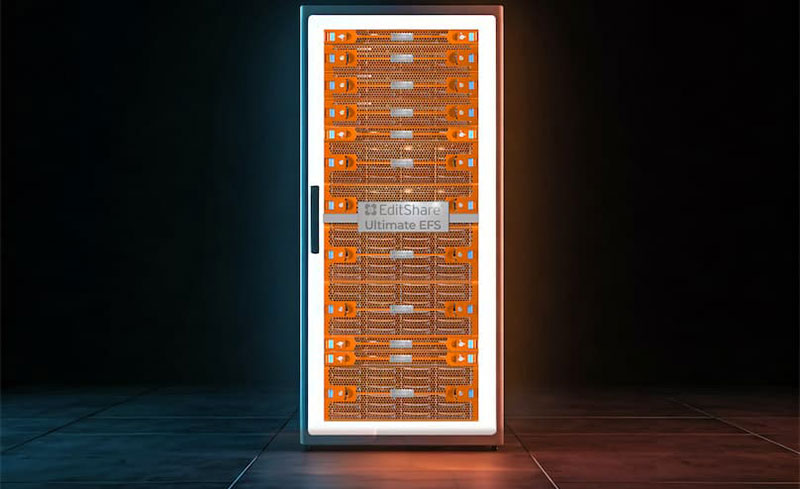
The continued evolution of the Ultimate EFS lineup was on display, engineered to support media workflows across creative applications including Avid Media Composer, Adobe Premiere Pro, DaVinci Resolve, Final Cut Pro, Autodesk Flame and Baselight.
Ultimate EFS NVMe Lite
The new Ultimate EFS NVMe Lite is an efficient way for teams to move into all-NVMe shared storage. It delivers NVMe-class bandwidth without immediately deploying a high-density NVMe cluster. It uses an 8-drive NVMe architecture to balance performance, density and cost, and has the same Ultimate EFS architecture, but in a smaller, scalable package.
EFS NVMe Lite works at up to 14 GB/s of aggregate read performance per node, supporting multiple editors working concurrently with UHD, 4K and high-bitrate media without dropped frames or stalled playback. This would support multiple-stream editorial timelines, online finishing and conform and high-speed ingest.
Running the EditShare File System (EFS), NVMe Lite features media-aware file system behaviour, and intelligent file locking and metadata handling. Its native client performance gives stable playback under load.
Not a standalone storage appliance, NVMe Lite has access to FLOW for asset management, automation, search, metadata and proxy workflows, as well as FLOW AI for automated media analysis, generating searchable metadata. ARK integration for archive and restore is included. This approach allows teams to manage, move and protect media as part of a single connected workflow.
NVMe Lite uses the same scalable, clustered architecture as other Ultimate EFS systems – for example, a three-node cluster can deliver over 40 GB/s aggregate read performance, serving as a path from entry-level NVMe to high-performance production environments. Multiple nodes combine into a single clustered system with a unified namespace, so users continue to see one storage environment as performance and capacity increase.
Ultimate EFS Hybrid
Ultimate EFS Hybrid is made for environments where performance requirements vary across projects or over time, and has two storage tiers integrated within a single node – an NVMe tier for high-bitrate editing and finishing, and a HDD tier for active projects, nearline storage and larger media sets. This configuration is useful for managing multiple projects with different performance demands, facilities that occasionally require high-bitrate or file-per-frame workflows, or situations where storing all media on NVMe is not affordable.

Each tier operates independently, allowing the user to define where media resides based on workflow requirements. Media can be moved between tiers quickly and without disruption, so projects can shift between performance and capacity as needed. This makes the system suitable for workflows that need both performance and high-capacity storage in a single system.
EFS Hybrid can be deployed as a standalone system or as part of a larger EFS environment, where nodes are added to increase capacity and performance, while maintaining a single unified namespace across systems and expanding without disrupting active workflows. Like Ultimate EFS Lite, EFS Hybrid has access to FLOW for asset management, and FLOW AI for automated media analysis.
At NAB, EditShare again partnered with Lasergraphics to show high-resolution film scanning captured directly into an Ultimate EFS NVMe storage node. In this demo, attendees watched 4K and 8K DPX image sequences ingest in real time and move immediately into playback and grading in DaVinci Resolve, illustrating the huge, sustained shared read and write bandwidth required for film restoration and archive workflows.
Enterprise-Grade Security and Compliance
EditShare has continued to invest in protection for users’ intellectual property. MediaSilo has officially joined the TPN+ (Trusted Partner Network) community, representing the industry’s highest standards for content security. The company is also undergoing the assessment process for the TPN+ Shield certification. This assessment will ensure that MediaSilo users can collaborate, knowing their workflows adhere to security best practices defined by the Motion Picture Association (MPA). editshare.com