


The new Harmonic AI orchestration service allows broadcasters, streamers and providers can integrate AI applications into live video workflows with broadcast-grade reliability and security.

Through the new Harmonic AI orchestration service, broadcasters, streamers and service providers can integrate AI applications into live video workflows with broadcast-grade reliability and security. Media companies can use the service to enhance their workflows, efficiently and securely, with expert AI applications developed by Harmonic and its partners. As a result, service providers have the potential to lower AI-related investments and accelerate time to market for more personalised, cost-effective live streaming and broadcast services.
“As video workflows become more complex and distributed, media companies are interested in adopting AI tools but face challenges with fragmented AI tools, complex integrations and inconsistent reliability,” said Yaniv Sibony, vice president of growth product management at Harmonic. “Our new AI orchestration service gives users more control by enabling multiple AI applications to operate from a unified control plane. Reliability and security are built-in as features, helping media companies innovate faster, reduce complexity and bring AI-assisted video experiences to market with greater confidence.”
Unified AI Control Plane
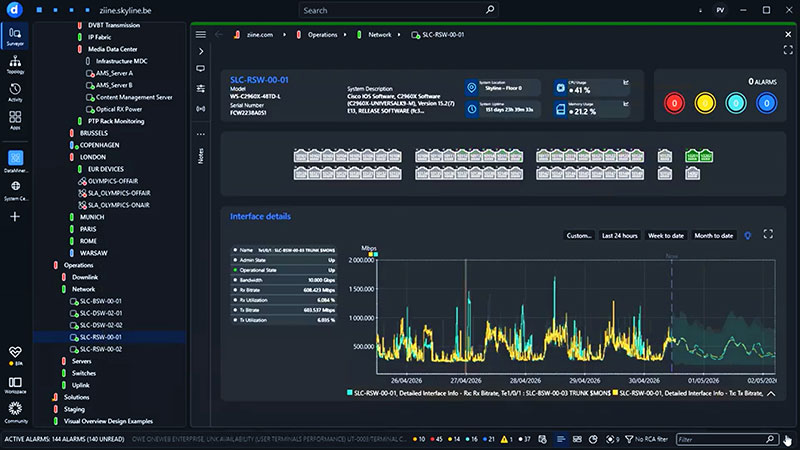
Harmonic’s AI orchestration service aggregates, orchestrates, maintains and updates AI applications implemented by Harmonic and its partners. Service providers can configure, schedule and activate AI applications dynamically through one interface, making operations simpler and more cost-effective. The service coordinates AI-based processing for live content, synchronizes outputs frommultiple AI engines and ensures direct failover through built-in redundancy mechanisms.
Available as a stand-alone SaaS, the orchestration service supports a suite of AI-driven applications including real-time audio translation and transcription, dubbing and localization, automated live sports highlight generation, scene-level metadata generation, ad-break detection and in-stream ad triggering. Built for the broader ecosystem, the service works natively with Harmonic’s media processing solutions including VOS 360 Media SaaS, VOS Media Software, XOS media processor and Spectrum X Plus.
Redundancy and Reliability
As well as managing multiple AI vendors from the single, secure control plane, providers can align AI outputs precisely across multiple engines so that media companies are able to deliver frame-accurate broadcast and streaming services. Furthermore, the failover mechanisms built into the system, combined with security and health monitoring for AI tasks, give service providers the redundancy they need to prevent on-air disruptions. They can also schedule and activate AI applications on a per live event basis.

By unifying multiple AI applications into a single platform, tackling AI orchestration as a service means media companies can avoid paying for expensive integration cycles and rip-and-replace upgrades as AI technologies evolve. Ultimately, the Harmonic service accelerates time to market for their clients’ new AI-powered services by eliminating the need for repeated platform migrations.
VOS Hybrid Video Streaming
Regarding Harmonic’s VOS Hybrid Streaming – that is, integrating on-premises infrastructure and the cloud – the new AI orchestration service means VOS users now have an AI-agent connectivity platform purpose-built for video streaming operations. Featuring standardized MCP (Model Context Protocol) connectivity, centralized control and unified access to operational data, the solution enables service providers to integrate their own AI agents with Harmonic’s central management technology to build capabilities such as root cause analysis, self-healing, cost optimization and intelligent asset movement – keeping operations up to date.
These types of AI agents are useful in VOS streaming because it addresses VOD and network PVR storage management. Newly released or recorded content is in high demand, while older assets take up valuable storage space. VOS enables providers to store slower moving archival content on public cloud — while processing live, fresh content on-premises to meet demand more quickly. It has the same centralised, single-interface approach, and allows automated rules-based content migration.
More VOS Hybrid Streaming Updates
Other VOS Hybrid Streaming updates concern the VOS Media Software, which the streaming solution uses to support its entire video workflow. Optimised for the Red Hat OpenShift platform, VOS Media Software is architected as containerised microservices that use OpenShift's orchestration, security and scaling capabilities. Thus, Harmonic’s hybrid streaming solution on OpenShift addresses both broadcast and OTT applications on a single unified platform, and enables service providers to quickly launch services including premium live streaming, time-shift TV, network DVR and targeted ad insertion.
Harmonic’s hybrid streaming also uses intelligent, policy-driven orchestration of video content across hybrid infrastructure. It analyses content access patterns and automatically moves VOD and network PVR assets across storage tiers based on demand, performance requirements and cost-optimization policies. By combining origin heat analysis with policy-driven asset migration, it enables service providers to simplify operations with its centralised visibility, avoid manual asset management and thereby reduce storage costs. www.harmonicinc.com