


SMT worked with EVS’ MediaCeption to deliver a complex, large-scale broadcast operation that met the event’s demands for a responsive, centralised production system with global coverage.
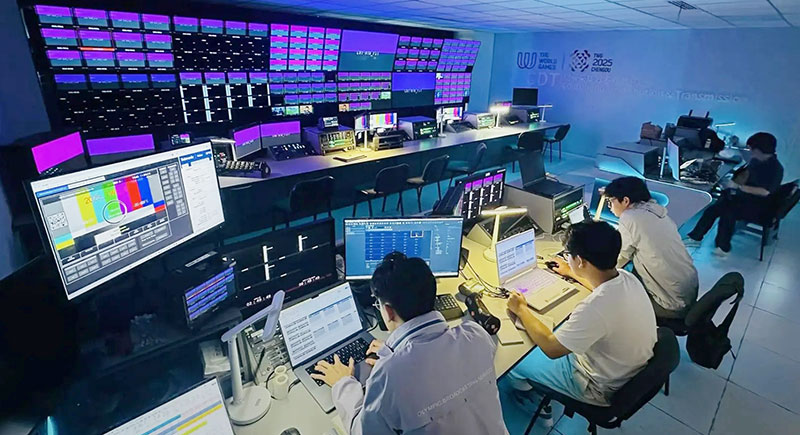
The 2025 World Games, held 7 – 17 August in Chengdu, China, hosted nearly 4,000 athletes from 116 countries, competing across 34 sports and 256 medal events. International Sports Broadcasting (ISB) was the official host broadcaster, and appointed Shanghai Media Technology Co (SMT) as service provider to help them reach a worldwide audience.
The project put SMT under pressure to deliver a complex, large-scale broadcast operation that met the event’s heavy demands for stability, comprehensive functionality and responsiveness.
Therefore, the team’s intention was to build a solution on a modular design that would allow them to combine reliable, mature broadcast systems with the agility, scalability and efficiency needed for modern multi-venue, multi-sport production. The solution also had to accommodate local production requirements while supporting global broadcast coverage.
To form the basis of its production strategy, SMT evaluated various options for media management, and selected the EVS MediaCeption solution. On this foundation, the team deployed EVS’s LiveCeption for replays and highlights.
Orchestrating Simultaneous Production Workflows
Producing events of the magnitude of the World Games means managing and orchestrating a large number of simultaneous production workflows, which calls for a centralised system. Without centralisation, SMT’s operators were likely to find themselves running fragmented workflows, making redundant media transfers and working with inconsistent versions, which would lead to slow turnaround and a higher risk of editorial and operational errors.
The core challenge was to unify the environment, end-to-end, and make it capable of high-volume ingest with structured media management including comprehensive metadata logging and content enrichment. On the production side, the team needed to produce fast-turnaround highlights and clips, and handle editorial of the incoming material, from rough cuts to tight integration with craft edit environments. SMT also wanted to be able to set up virtualised deployments, in order to accommodate last-minute change requests from ISB.
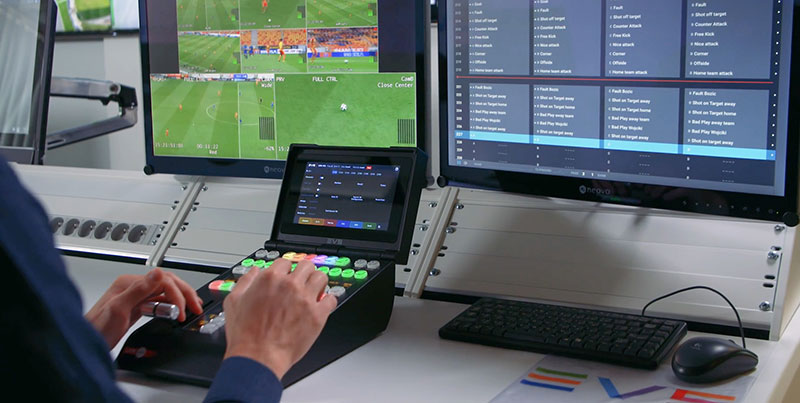
In short, SMT needed a central nervous system for the entire operation – scalable, integrated and built for real-time collaboration across multiple teams and formats. Having this system at the centre would help them maintain reliable, 24/7 live playout and direct, timely distribution to international rights holders. It would also support efficient archiving and retrieval for later re-use of content.
Unified Production Backbone
EVS and SMT worked together to customise a system built around EVS’s MediaCeption and LiveCeption solutions. ISB and SMT’s production teams also engaged in multiple rounds of technical discussions and joint system design to make sure the resulting system aligned precisely with ISB’s requirements while taking advantage of EVS’s product strengths.
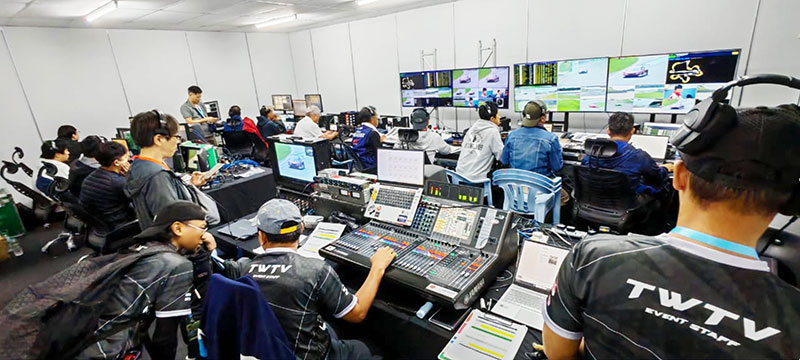
The final solution functioned as a unified production backbone, running 20 workstations and nine craft-edit suites, with an integrated highlight-production and playout workflow. All feeds were ingested directly into EVS production servers, turning the system into a real-time media hub where operators could log, enrich and use the content as it was recorded.
Teams were able to access the growing files instantly, cut replays of key moments of the competition within a few seconds, and publish them back to the EVS network for immediate playout or delivery to rights-holders. Similarly, rough cuts moved directly into Adobe Premiere Pro for finishing, and were then made available in the EVS environment.
The SMT logging team implemented metadata profiles for flexibility, and timecoded their annotations to precisely match the live content. The metadata logs gave deep, timecoded searchability across thousands of assets captured from the varied sports disciplines and key moments of the event, and made it possible to fit the production’s editorial requirements.

Because every workstation was tied to the same synchronised media platform, SMT’s teams could work in parallel – ingesting, logging, editing, playout out and distributing – throughout the event.
Resource Utilisation and Allocation
Within their decision-making process, SMT felt EVS’s solution stood out ahead of alternatives because it met immediate operational needs along with the potential to support future long-term workflows, including cloud integration and AI-driven production. Virtualisation was a key aspect of the project for SMT, using software to divide the physical servers into multiple isolated virtual environments.
Having an abstraction layer between hardware and software improved server resource efficiency and increased deployment flexibility. The virtual servers could be quickly created, modified or decommissioned without changing the hardware. It allowed SMT to respond rapidly to last-minute changes from ISB by allocating resources based on workload demands, and also to optimise system configuration after the event.
Combining Innovation with Localisation
“Partnering with EVS goes beyond technology – it’s about joining forces to achieve outcomes neither of us could reach alone. By combining EVS's innovation with SMT's deep localization expertise, we've established a model for China's next-generation broadcast infrastructure,” said Roman Ling Chen, Deputy General Manager at SMT.
As SMT intended, the overall system was designed around a modular architecture, enabling components to be grouped, split up, reassembled and redeployed as needed. This modularity created a reusable technical foundation for future events, effectively balancing short-term project delivery with long-term resource utilization.
In terms of speed, MediaCeption gave SMT’s production teams the means to quickly locate, create and organise clips through straightforward interfaces and fast content search tools. SMT could also scale the production where needed through flexible resource allocation and immediate access to both EVS video server content and traditional storage – which also eased collaboration between production teams. www.evs.com